Showing posts with label Wheatear. Show all posts

Tuesday, 19 October 2010

17 Oct-Ringing in the Hollow

Today, at long, long last, almost two months after returning from Long Point and vowing to try it out again, I went up to the ringing at Whitbread Hollow, Beachy Head!

Dad and I left the house at about 7.30 AM, arriving at 8.00. Driving the 15 miles, I counted 31 Magpies along the roads! Not exactly the most exciting thing in the world, I know, but I was wondering if the rhyme could be extended that far!...  ;)

The sun was just rising above the sea as we arrived, making a spectacular backdrop. However, I couldn't be faffed to take any photos.

As we walked the short distance from where we were parked to the Hollow, several Stock Doves passed overhead, among a few hundred Woodpigeon. Two Bramblings also passed over, one dropping down into the hollow, and we saw a single Wheatear, probably my last of the year.

Wheatear, Whitbread Hollow, 17 Oct 2010
In the Hollow itself, the first bird we saw was not what we expected. On the football fields, being harassed by several Magpies, was a single juvenile BRENT GOOSE! It had clearly become separated from its family, and had dropped into the fields to graze. No sooner had we seen the bird than we met up with Bob Edgar and Jacob Everitt, just back from a net round. With four people now here, they had a novel, if a tad optimistic, plan, involving the branta. It was feeding very near some football nets. If the four of us could drive it in to them, we would have a rather good bird to ring!

Sadly, the plan, as with all hastily set out plans, went awry. The bird was faster on the mark than us, and flew off about 50 yards, away from any football nets. Worse still, the coldappeared to have  mucked up my cameras batteries! Though after about half an hour in the relative warmth of the ringing hut, they were working again.

We stayed for a few hours to watch the ringing. I didn't get to help out, unfortunately, but it was still good fun watching the ringing and holding the birds, and Bob and Jake, far more used to the early start than us, remained in upbeat moods! They banded about 40 birds, not a great tally, and nothing particularly rare either. However, seeing Goldcrest and Long-tailed Tit in the hand was new for me. They are both truly adorable little birds when you see them up so close! We also caught a few continental Song Thrushes, which Bob very well pointed out the ID features on. Other birds trapped were a male Blackcap, several Chiffchaffs and a little flock of Blue Tits, all of presumed dispersive origin.

male Goldcrest, Whitebread Hollow. sexed by the orange feathers on the crown


Whitbread Hollow, Beachy Head


Whitbread Hollow is a great place to see visible migration too, which was very visible. loads of Siskin were passing over, with smaller numbers of Goldfinch, and a handful of Redpoll and Brambling. A few of the latter were also in some of the bushs in the hollow. 1500+ Woodpigeon also went east, with 30+ Stock Doves among them. One leucistic Woodpigeon was also seen, it was with one flock that flew over and dropped into the hollow, and all four of us got a good look at it, agreeing we hadn't seen anything quite like it before! About 50 Swallows and a few House Martins went over, and thrushes included one Song Thrush, three Mistle Thrushes and four FIELDFARE, my first of  the winter. Meadow Pipit and Skylark were ubuquitiuos as always.

We left at about 11:30 AM. It had really quietened down, with the  last two net runs having returned about five birds!

After the Hollow, we had a brief stop at Belle Tout. I was hoping for third time lucky with the gorgeous Phyllosc, but it had had other ideas, and was believed to have cleared out overnight! There were a few Chiffchaffs around, and a group of Siskin passed overhead, while a Kestrel and several dragonflies kept the camera busy!

This Kestrel posed brilliantly


and while photographing it, I took the opportuity to photograph this male Ruddy Darter (?), who landed on my shoe!


another presumed male Ruddy Darter


while I believe these to both be females of the same species. If Jake, or anyone else, could confirm/correct me again I'd be grateful. Just a hint  (:

Saturday, 25 September 2010

25 Sep, double score!

Late September is my favourite time of year. My first ever local comittee rarity, a Goshawk, was seen exactly one year and 364 days previously to today, in exactly the same area I was walking today. 362 days ago, I saw a Glossy Ibis in the Lower Cuckmere (although I wasn't the original finder that time). And today, I bagged two local rarities, and nice additions to my Self-found list too!

Having noted an execptional movement of birds throughout yesterday around Seaford (two Hobbies, four Grey Wagtails, 350+ Hirundines and 20+ Meadow Pipits) I thought today would be a good day to get out. With clear skies in the morning, it looked to be a good raptor day, although I wasn't too sure about grounded migrants. I opted to walk out to Firle Beacon, where there would be a good chance of seeing any raptors moving.

Along, Firle Road, Seaford, I heard my first migrants, a few Chiffchaffs and Goldcrests calling away in the gardens. There were also a handful of Swallows and House Martins overhead.

On Seaford Golf Course, I recorded a total of 14 Chiffchaffs, 7 Blackcaps and 4 Goldcrests. Single Yellow Wagtail and Meadow Pipit both flew south, and I got a brief view of a Redstart in flight. A flock of Long-tailed Tits, 15+ strong, passed along the pathside. There were also loads and loads of Speckled Woods, some posing very well for shots

A tatty Speckled Wood


While this one was almost pristine!
Hobbs Hawth and Five Lord's Burgh, the areas between the Golf Course and Firle Beacon, where almost devoid of migrants in the windswept weather. about 60 each of Swallow and House Martin were whizzing around, as were 20 Linnets and 30 Meadow Pipits. A Bullfinch called, but just 5 Chiffchaff and 2 Blackcap were recorded, the wind being at least partly to blame here.

The view from Firle Beacon was spectacular...

The birds were pretty good too.

They included 80 Meadow Pipit, 25 Chiffchaff, 15 Swallow, 5 House Martin, 2 Buzzard and single Yellow Wagtail, Sparrowhawk, Wheatear (shown below) and what I thought was a Redpoll, flying south calling. Suffice to say, I was to discover I was wrong, eventually...


a rather lovely Wheatear at Firle Beacon
However, by far and away the best bird I managed to see was over the wood at Bo-peep. A raptor was being blown in the wind. It flew over the wood, at treetop height, in view at a range of 30 metres for about 10 seconds. It wasn't a Marsh Harrier. It wasn't a Common Buzzard. It was a damn fine looking, dark-phase, fairtrade chocolate HONEY BUZZARD! Regrettably, I never got a good view of the tail, so I'm still weighing up whether it is worth a description. But even if not, it is my first self-found HB and I'm rather happy with it!

As I walked the 31/2 mile walk back to Seaford, still on cloud nine, I didn't see too many more birds. Greenway Bottom held a few Meadow Pipits and Linnets, and two Buzzards, a nice comparison with the Honey Buzz. Goig back through Seaford GC, I found this (very!) recently deceased Red Admiral.


R.I.P, the one that didn't make it to hibernate again.
Back Home, about 6.00 PM

what I thought was a Redpoll, flying south calling. Suffice to say, I was to discover I was wrong, eventually...

I had heard a mysterious bird flying south calling earlier today. It bore some resemblance to a Linnet call, but was at the same time distinctive, and having heard plenty of Linnets, I knew this sounded different. Stuck for ideas, I took my next fallback, a Redpoll.

But, being nosy, I decided to check Redpoll calls on Xeno-canto when I got home. And it became apparent I was wrong in my ID. It wasn't a Redpoll. Or a Siskin. Or a Linnet, or any other finch. However, when I came accross this page, my queries were happily resolved!

That's right, a second brilliant self-found bird, a LAPLAND BUNTING! With so many around at the moment, it isn't too surprising. I saw one less than two weeks ago, in fact. But as a self-found bird, they don't come much better.


As I said before, I love late September!


My totals for today were
Meadow Pipit-120+
Linnet-100+
Swallow-90+
House Martin-70+
Chiffchaff-55
Long-tailed Tit-30+
Blackcap-9
Goldcrest-6
Buzzard-4
Yellow Wagtail-2
Bullfinch-1
Sparrowhawk-1
Wheatear-1
Redstart-1
HONEY BUZZARD-1
LAPLAND BUNTING-1

Saturday, 18 September 2010

Arlington Reservoir

Amongst plenty of Pied Wagtail at Arlington today, at least two White Wag's, an adult and a juvenile. The only other birds of note were 100+ House Martin, 20+ Great crested Grebes, 21 Cormorants, a few Wigeon (my first of the winter), a Wheatear* and a Muscovy! No Little Stint, nor a wader of any description!


Muscovy Duck


An adult White Wagtail


Pied or White?? I think Pied but not entirely sure.


The water level was incredibly low!!


At High and Over, just a few Chiffchaffs and a Blackcap, though a Reed Warbler and four Spotted Flycatchers were reported here on the SOS. The Crane my dad and a few others saw in the Cuckmere early morning was nowhere around.

On a sadder note, yesterdays White Stork was found moribund and taken into care by the RSPCA.Hopefully it will recover but its not looking too good for it.


* edit-The Wheatear I saw at Arlington looked kind of odd at the time. It was a female type bird, and had a very rich peachy breast, with the colour extending down more than usual. It also had an unusually brown back, and pretty obvious Supercilium. I didn't take in much detail of its posture, and there were no other Wheatears for size comparison, but I am now fairly confident it was a Leucorrhoa, or Greenland Wheatear. I've seen them in the spring, but this was my first autumn record. I'm not sure if it is good enough to record as such, but morally I feel happy enough about this birds identity.

Friday, 17 September 2010

Clawing one back!

16 Sep 2010

Unpertubed by previous failure in any attempt at connecting with Lapland Bunting, White Stork or Pied Flycatcher this afternoon, me and Dad tried again in the early evening. We got one, and missed the other two, but who really cares about a Pied Flycatcher when you can see a Lapland Bunting?

Our first stop was at High and Over, for a scan of the Cuckmere, and one last attmpt to see the White Stork. we peered over the entire valley from Exceat to Litlington, but saw just a handful of Little Egrets. However, a constant stream of Meadow Pipits was going south. Due to our elevated position most were going either level with or below us, while Swallows and House Martins were flowing down the river in good numbers. The bushes of High and Over held a few Chiffchaffs and a Blackcap, doing a canny little subsong, while a Redstart/Willow warbler was heard.

We then  drove down to Seaford Head again. Matt Eade, Jake Everitt and Marc Read were all looking for the Lapland Bunting in the little muddy field west of South Hill Barn. Dad and I were just going over to ask if they'd seen it when the Bunting appeared from nowhere, disappearing into some long grass on the edge of the field.

All five of us then slowly snuck up on it, and after about a minute it showed brilliantly, allowing us to see every single little detail of that adorable little bird. It flew off after about 30 seconds, into a tussock of grass about 50 yards away. Here, it remained invisible for not much more than a minute, til inevitably a dog-walker strolled by, flushing it into the muddy field, where the restless little longspur stayed for about 10 seconds before going off again into the tussocky grass, now slightly more safe from accidental flushing.

Having seen this brilliantly, Dad and I opted to give the Pied Flycatcher another go. But Harry's Bush was deathly quiet, and the grand total of 15 minutes searching every single bush, tree and shrub in the area was one little Chiffchaff. It was a very nice Chiffchaff indeed. But it was still just one measly Chiffchaff.

We then did the sensible thing, and traipsed back to admire the Lappie, in he company of two Wheatears. Together with Jake and a few other birders, we got even better views of this fantastic bird, through the scope for about 15 minutes, before we left the rest of them to it and answered the calls of our stomachs.

Success? I think so!

the best photo I could get of a great bird, click here for a better photo, or here, here and here for what we dipped

Monday, 9 August 2010

6 hour stint at Seaford Head

woke up at 05:00, tiptoed around the house getting ready, left at about 05:30 by bike and I was at South Hill Barn by 06:00.

The first migrants I saw were 3 Whitethroats, a Willow warbler and a Lesser Whitethroat from the lower half of the small copse by the car park. in the top half were single Willow and singing Reed Warbler. Walking down the path from the car park to Hope Gap there were a few  more Whitethroats, with a female Blackcap and a Lesser Whitethroat mixed in.

Walking down through Hope Gap was good first time round, with the sun breaking onto the bushes a sudden flurry of activity came and went, with 13 Willow Warblers, 19 Whitethroats, 9 Lesser Whitethroats, 4 Blackcaps, 3 Reed Warblers, a Garden warbler and a Chiffchaff noted. The highlight were seeing the Chiffchaff posing well with two Willow Warblers, a nice comprison between the two, showing how different they can really look in autumn. Down one the rockpools was a single Whimbrel, 2 Gannets were loafing offshore with some Kittiwakes and another one passed east. Walking along the west side of Hope Gap revealed a few Whitethroats, 3 Lesser Whitethroats, and 2 each of Willow and Reed Warbler, while the highlights were a croaking, but invisible, Nightingale, and a fly-over Tree Pipit, my first of the autumn.

Somewhere along here I saw Matt Eade and Bob Self ahead of me, and caught up with them at the top of the path through Hope Gap. I walked back down with them, hoping a tape recorder might lure out some more birds, but in the end saw mostly the same birds as before, along with another Nightingale croaking away.

after this followed a virtually birdless walk along to the Coastguard Cottages. a few Whitethroats, 2 Lessers and a Willow warbler the 'highlights'. However, there was a nice Silver-spotted Skipper, which Matt got some brilliant photos of, and which are probably on his blog by now. Once we reached the Cuckmere, with 3 Wheatear, a Ringed plover and a Dunlin(looking for all the world like a Broad-billed Sandpiper!) there to greet us, we went our separate ways, Matt and Bob back to the car park and me along the Cuckmere. 1 Lesser Whitethroat and 1 Reed Warbler, in bushes running down one of the drainage ditches, broke the monotomy, but it started getting interesting again along the west side of the valley. In the bushes along here were a handful of Whitethroats, 7 Lesser Whitethroats, 9 Willow warblers and 3 Reed warblers, while on the walk I could hear at least 2 Sandwich Terns distantly over the sea. One of the Lesser Whitethroats was incredibly close, I was eye-to-eye with it, at almost touching distance, for a few seconds, although they dragged out into eternity. I could see the bright white eyering and the beady black eye in minute detail.

Here I realised that, almost without trying, I had racked up a total of 21 Lesser Whitethroats!! i was tempted to narrow it down a little and take a few off to make my total more 'realisitic' but that 21 was a bare minimum, on the walk I had 10 or so other quick views of possible birds and brief tacking from bushes that I couldn't confirm, so perhaps as many as 30 Lesser's were in the area!

Harry's Bush was dead other than a Willow warbler and a female Blackcap, but up on the mast were 7 Willow warblers, 3 Whitethroats, another Reed Warbler and the star bird of the day, a juvenile Whinchat. At first I could clearly see it was a chat, but equally, that it didn't look like a stonechat. If I could have remembered to look at the tail when it flew, I could have saved a bit of time (20 minutes scouring the bushes for the damn elusive creature!), but the short tail, plumpness, obvious supercilium, buffish breast and that much cuter expression than a Stonechat left me happy to have found Seaford Head's first Whinchat of the autumn.

the totals were
46 Whitethroat
33 Willow Warbler
21 Lesser Whitethroat (a record count for me)
11 Reed Warbler (also a record count)
6 Blackcap
1 Chiffchaff
1 Garden Warbler
1 Tree Pipit(sussex yeartick 157)
2 Nightingales
3 Wheatears
1 Whinchat(sussex yeartick 158)
1 Whimbrel
1 Ringed Plover
1 Dunlin
3 Gannets

Saturday, 7 August 2010

Seaford Head and Cuckmere Haven-7 August 2010

55 Whitethroat, 41 Willow Warbler, 4 Garden warbler, 14 Lesser Whitethroat, 6 Reed warblers, 1 Blackcap, 2 Wheatears, 1 Whimbrel, 21 Curlew and 30 Meadow Pipits. For four hours in the field I'd have liked  bit more but as soon as it kicks off properly it should be good up here. Just hope autumn gets going bfore I get going across the atlantic!

Monday, 26 July 2010

first visit to the patch

today was my first autumn visit to the local patch at Cuckmere Haven and Seaford Head. July is a time when the first few warblers are moving through, and waders are in full swing, and I saw a few of both today.

The first presumed migrant I saw was a Whitethroat on the Golf Course. walking along the east side of the course I saw a few more, and got a brief glimpse of a Lesser Whitethroat, while walking up through the wood on the south side of the Golf Course, there were 2 Willow Warblers. Around the mast, I saw my first few Swifts passing overhead to the west. There were a few more warblers, 2 singing chiffchaffs (presumably territorial and not migrating yet), a few Whitethroats, two Lesser Whitethroats, and a singing Reed Warbler. resident birds included a calling Bullfinch and several family parties of Linnet, Goldfinch, Chaffinch, Greenfinch and Blue Tits.
There were singing Skylarks and Meadow Pipits around the Golf Course, and along the clifftop a few family parties of both were feeding in the short grass. The only migrant along here was a Wheatear, a fairly early record for autumn. the pair of Ravens were very showy, approchable down to a couple of metres, the best and most prolonged views I've yet had of them. most fantastic was as one then the other bundled accross the path, dropping off the cliff-face before swooping back up again. At the same time, five Swifts flew past, barely at head height and practically touching distance.
A few minutes later a group of 40 Swifts flew over. I only picked them up (mostly so high up I needed binoculars to see them) by their calls, so many others probably passed high overhead during the morning undetected. On the western path along Hope Gap I saw a few Willow Warblers, including one singing male. I also saw a few Whitethroats, 2 Lessers and a Reed Warbler. down the middle path through Hope Gap was quiet, there was a Chiffchaff, a few Willow Warblers, 10 or so Whitethroats, 5 Lesser Whitethroats and 2 Reed Warblers.
A few more Lesser Whitethroats and Willow Warblers were along the east side, with one Reed Warbler, while more Swifts went overhead and 3 Sandwich Terns were heard off Hope Gap.
In the area around the Coastguard Cottages it was deathy quiet, a few Whitethroats being as good as it got!
In the Cuckmere Valley were decent numbers of hirundines, 50 Swallows, 10 Sand Martins and a handful of House Martins passing through. 2 Green Sandpipers and a Common Sandpiper were in the ditches on the west side of the valley, there were 2 Curlew on the river and a Whimbrel circled the valley several times before dropping into the pastures with a group of 3 Curlew. In the bushes along the west side of the valley were several more Lesser and Common Whitethroat and 1 Reed Warbler, with 2 Lesser Whitethroats and a Willow Warbler around Harry's Bush, and at least one more Lesser Whitethroat noted on Seaford Head Golf Course (I heard two in the area where I had seen one five hours earlier).
By the end of the day, totals stood as follows;
Common Whitethroat-32 (most likely the majority were breeding birds or has dispersed from very nearby)
Lesser Whitethroat-17 (a very good count, especially for July, and a personal record for the patch)
Willow Warbler-15
Reed Warbler-7
Chiffchaff-4 (singing males, probably still on territory)
Wheatear-1 (the first of the autumn and quite early, though possibly dispersed from the breeding pair at Cuckmere Haven)
Swift-122 west overhead, but probablyt many more I didn't pick up
Swallow-50+ passed through Cuckmere Haven
Sand Martin-10 passed through Cuckmere Haven
Sandwich Tern-3 off Hope Gap
Curlew-5 in lower Cuckmere
Whimbrel-1 in lower Cuckmere
Redshank-1 in lower Cuckmere
Green Sandpiper-2 in lower Cuckmere

Saturday, 10 April 2010

fantastically bonkers day in the Cuckmere, 9/4/2010

It didn't look like a good day for birds in the Cuckmere. The wind was light S/SW, and by the time I arrived the world and several distant relatives of its had trampled every square metre of my precious patch. Things didn't look very promising at all for the first half an hour, with a pair of Shelduck and a solitary phyllosc (probably a Willow Warbler) the highlights. Things picked up a tiny bit on the east side around the meanders, with this unusual escapee among the Canada Geese.
With the addition of the Bar-headed Goose, my spirits were lifted somewhat, and they went a notch higher with a distinctive wailing 'peeuw' call that I heard from the river. After two minutes of patience and some attempts to call it out (it was a call farly easy to mimic), I got a brief view of a Little Ringed Plover. However, a dog plundering through the saltmarsh sent it back out of view, and it didn't look like it would come out again. Around the back of the scrape, during my first look, I saw a Wheatear and a pair of Stonechats. 2 White Wagtails were feeding on the edge of the scrape, and a Swallow was hawking over the scrape and the surrounding fields. From here I went to check the sea, and I found this dot offshore.


believe it or not, this is indeed a Black-necked Grebe! It was so distant, I only managed to ID it after zooming in on the photos a huge amount, and even then I could only tell it apart from slav grebe by shape. It was a summer-plumaged bird, usually one of the finest sights in birding, but sadly, no matter what angle I tried to look at it from, it was constantly in Silhouette. After taking all these photos, my camera had run out of battery, I didn't think this would be a problem, as I doubted I would see anything much more interesting during the rest of the day.

However, by now it was about 3.00, and a lot of people had eft the Cuckmere. I walked back up to the scrape, and was looking at the White Wagtails again when I turned around and noticed something sitting on a fencepost about ten metres away. On my first look, I could see it was a Pipit, and an odd one at that, with a striking supercilium, an all-black beak and a greyish coloured head. It dived down into a ditch, but reappeared, and this time I got an excellent view for about 15 seconds. I noted that it had a browny-grey back and wings, long legs and a long tail, and a breast with a few pale streaks on the upper breast, but otherwise the breast and throat were very clean white. I had now narrowed it down to Water Pipit or Scandinavian Rock, but luckily I had the old Collins Field Guide with me. What I had seen ooked very much like a typical Water Pipit, but in the book was an illustartion of a rare variation of Scandinavian Rock which was very pale and grey. The illustartion showed it to have a dark malar patch, and when the Pipit appeared again, I checked, and it lacked that patch, leaving me with quite a clear cut Water Pipit! However, before long it flew off, showing white flanks to the tail, another good marker for this species. It called now as well, a sharp, explosive 'tseeeeep', very similar to Rock Pipit but subtly higher-pitched and more drawn out, giving a more evocative feel. Following this, I frantically searched all the small creeks and floodwater around the Scrape. The number of White Wagtails around was now at least six, the Swallow was hawking the fields again, there were plenty of Meadow Pipits, 5 Snipe were flushed from one of the islands on the scrape by a goose plondering through the grass, and a Little Ringed Plover showed well on the scrape. But in all this madness, I couldn't find the Water Pipit, and eventually gave up, heading back up the river towards Exceat Bridge. I heard the other Little Ringed Plover calling away from the river, but it wasn't immediately visible, and I couldn't be bothered searching for it again. However, at ht epoint were the meaders started, a pipit flew up from the bank of the river and landed on the shore of them, uttering exactly the same call as the Water Pipit I had heard earlier. It was indeed the same bird, and, at a happy distance and with no one else nearby, provided good views for five minutes, n the company of a Meadow Pipit and a Reed Bunting. There wasn't much else to look for now I had all the major details, but I piad more attention to its shape. It had proportionately longer legs and tail than the accompanying Meadow Pipit, and had a longer-necked, slender, more upright stance, similar to Richard's Pipit.

Walking back up the river, over the bridge and up Chyngton Farm, I saw the Bar-headed Goose on the meadners, with another Swallow and two Sand Martins hawking above. Two juvenile gulls n the meanders proved to be a Great Blackback and a Yellow-legged, with a nice comparison between the two easy. Finally, I saw two more Swallows over Chyngton Farm, and a group of 7 Shelduck feeding together in the fields below, before heading home pretty much on cloud nine!

Saturday, 13 March 2010

13 March 2010, two year ticks and many signs of spring!

A day that always promised a lot of birding activity, and in whcih I got to use my newly acquired camera quite a lot!

It started in the early morning, with a few Redwings still present around Seaford, along with a calling Great Spotted Woodpecker from my back garden, while I managed some nice photos taken of one of the local pigeons and a dunnock which has taken up territory in a very obliging bush on the corner of the street, and often shows very well.

After this, I cycled up to Seaford Head, hoping perhaps for a few migrants, but more for some camera-practice. Things started well, a few efforts to photograph crows in the fields at South Hill Barn coming out like this

Crows are among my favourite birds, being inquisitive, cunning and intelligent, however, I have already discovered this intelligence makes them difficult to photograph, They will stay put as long as you are moving, but stop and pull out a camera and in the time it takes to turn it on, the crow will prbably be a distant dot flying away on the horizon, or perched in a field too far away to photograph. However, the Carrion Crows in the latter picture posed well, being at just the right distance to feel 'safe', while the Magpie in the former picture was just luck and some heavy cropping at home as it disappeared over a hill! Also in the fields just to the north of South Hill Barn, a Fox ran through the sheep, causing momentary havoc, annoyingly it was gone before I could get a snap.

The next interesting thing I saw was a Peregrine flying strongly overhead, North over South Hill Barn. I was locking my bike up at the time so I couldn't photograph it, but it was so close I could hear the noise made by its wings as it rushed past!
At the small pond by South Hill Barn, frogspawn was a sure sign of spring around the corner (and for once the weather did feel like this today!), while the usual pair of Mallard posed well for some photographs.


In the pastures East of South Hill Barn, there were 300+ Starlings, with each sheep attracting its own small flock (see picture below), while two more Magpies where slightly more photogenic than the last one


I also took a photo of the sheep, just for the hell of it!

While walking along the path that runs along the eastern edge of this field, I saw a bird perched in one of the tallest bushes in the semi scrub (a mixture of tall-ish bushes and untamed brambles) to my left. It took off with a bouncy, loloping flight, similar to a Thrush or Woodepcker, and as it disappeared from view I got a brief glimpse of a white rump. a Wheatear!! It was my first of the year, the first in sussex this year (as far as I'm aware), and one of the first to be seen in Britain as a whole this year! (They have been much later arriving than in recent springs, it seems.) They tend to prefer open ground, but I theorized that this individual had probably been doing exactly that before the dog-walking mob descended on the cliffs, and had since taken shelter in the low-lying scrub of Hope Gap. I searched for it for twenty minutes or so, but could not relocate it.
While I was looking, I got this photo of a Jackdaw on the clifftop, presumably enjoying the sea view!
I had planned to walk along the clifftop in a vain search for more Wheatears, or perhaps a Black Redstart, but as I walked along the bottom of Hope Gap, where the sea is easily viewable, I saw two birds in the distance, I thought they would be gulls, but the looked diferent in shape, even from that range, and my suspicions were confirmed when they simalteneously dived, not typical gull behaviour! Walking down the steps at Hope Gap to the undercliff, I got a closer look and they turned out to be a pair of Great Crested Grebes. A few of these can often be seen from the coast in spring as the migrate east, but unlike other migrants, they never seem to be in a hurry, simply swimming along and letting the waves to most of the work for them. These two were no different, and thanks to a bit of running, followed by some crouching behind the strategically located boulders found on the undecliff, I got close enough for a few photos. These are very blurry, but you can clearly see that it is a pair, partaking in some pre-season courtship.
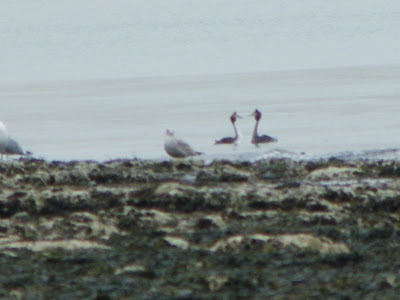
I followed the two of them along the undercliff, and as a result found a Fulmar nest above me, and got photographs of Oystercatcher and Curlew on the rockpools that were revealed with the tide. There were also several Rock Pipits along the cliffs holding territory, but I didn't get any photographs, hopefully within a month a walk along here might be greeted by their fantastic but often underlokked display flight.

Here the dedicated male is regurgitating food for his mate, presumably busy incubating their eggs

A Small oystercatcher in a big sea

While I was photographing the Curlew, a soft, whistling sound became apparent in the distance, which I identified as Wigeon. Gradually, it came closer, and closer, until eventually I saw about 100 of them flying out of Cuckmere Haven and out to sea. About 50 of these continued onwards and departed east, with the other 50 remianing offshore, at a distance of about half a mile, from whcih I somehow got this very distant record shot

After walking along the undercliff for about an hour, I eventually arrived at Cuckmere Haven. I didn't see anything else hugely interesting, but got a few decent photos, shwon below


a few Black-headed Gull images, taken from in the Cuckmere, with #1 being taken on the main river and#2 on the ditch that runs parallel to it on the West Side

and a nice chance to get Redshank and Oystercatcher in the same shot.

And finally, ending as I started, with an inquisitive looking pigeon in the dovecote at South Hill Barn!!

I also saw a migrating Meadow Pipit fly NW over the car park as I was unlocking my bike for the ride home.


However, I haven't quite ended. I saw a Tawny Owl, caught in our car's headlights on the way back from Brighton at about 7.30 pm. After the hard-earned year tick a few hours ago, this was somehwat luckier and somewhat easier!!! My yearlist is now 109 species., with the addtion today of Wheatear and Tawny Owl.

My Highlights of the day, as follows;
Red Fox-1 ran accross sheep fields near South Hill Barn
Peregrine-1 flying low NE over South Hill Barn
Starling-300+ in sheep pastures south of South Hill Barn
Common Frog-six clumps of Frogspawn counted in the small pond by the car park
Wheatear-1 in Hope Gap
Great Crested Grebe-a pair observed in courtship as they drifted east past Hope Gap, stopping off in Cuckmere Haven and still present in the bay when I last saw them
Wigeon-100 departing out to sea from the Cuckmere, with about half continuing east and the rest sitting on the sea half a mile offshore for atleast 10 minutes. 
Meadow Pipit-1 NW over the car park at 13:55
Related Posts Plugin for WordPress, Blogger...