Showing posts with label Great Crested Grebe. Show all posts

Saturday, 12 March 2011

first migrants/a year of photography

I saw my first real migrants of the year this morning, with a steady stream of Meadow Pipits moving over between 9.00 and 10.00 AM. I counted 10 in that hour, and since I was largely distracted by playing football there were undoubtedly more passing overhead. I also heard one Skylark moving North. Also today there were several Goldcrests singing in Seaford, one of which gave fairly good views in a small Conifer stand near my house, flashing his bright orange crest as he flicked through the twigs searching for a meal. A Carrion Crow building a nest near Newlands was another sign of spring arriving, and on Blatchington Pond both Mallard and Moorhen have been getting territorial. At School, the past few days have been slightly enlivened by the brilliant, scratchy little tune of a Pied Wagtail holding territory on the roof of the English block.

Also today, on the way into Brighton by bus, there were several rafts of Great Crested Grebes offshore between Peacehaven and Brighton Marina, totalling 100 birds or more. Probably another sign of migration, with birds gathering here before moving north.


on a final note, it is just over a year since I acuired the camera, whose awful photos so often litter my blog. I tend to take very poor photos with it, but I thought to mark my Pentax's anniversary I might post some of it's finer achievements in the last twelve months...

taken less than a month after I got my camera, this Jackdaw
on Seaford Head is still a favourite photo for me
There can't be that many people with photographs of a pair
of Nightingale on their breeding site. The male is hard enough
to see, but to be accompanied by a female is astounding luck
at the same location as the Nightingale shot (Abbot's Wood, Hailsham), is
one of only two sussex colonies of the very rare Pearl-bordered Fritilary
avocet and chick, taken at Rye Harbour in June
Rock Pipit carrying food at Splash Point, Seaford in July
Black Bear was one of the many highlights of visiting Canada in August!...
As was photographing a Sora in the hand at
Long Point Bird Observatory!...
and holding this Wilson's Warbler. Volunteering at Long Point,
I got to ring a few american Warblers and Thrushes, and practice
scribing and extracting birds. After this experience I decided I want to
learn how to ring as soon as I can here in the UK
autumn is great for all kinds of Fungi, especially in Abbot's Wood
despite spending a lot of time birding in the autumn, I got very few
good phots of the migrants I saw. But this Wheatear on Firle Beacon
makes up for all the rest of them!
Turnstones in a fairly classic pose at Longniddry, Midlothian in October.
A Benefit of having family in Edinburgh
In the snowfall of early December the garden birds must have been very grateful
for the food put out, they're never usually tame enough to get a photo like this
another garden bird in Snow, but this time in Worcestershire,
where we visited family over Christmas.
and finally, the infamous 'sun sets over an out-of-focus car' shot with
a small saving grace in artistic merit ; ) 
all in all, a pretty good 12 months has been had! These are just a handful of the thousands of photos I have taken in that time, of many bird, plant and animal species. Photography is such a fun pursuit and I'd urge anyone who hasn't already to go out and buy a camera. This pentax x70 only cost £250, and with a bit of patience and practice yields some brilliant results. I'd love to get a DSLR when I can afford one but for now mine is a brilliant camera that I will continue to use, continue to learn about and continue to take many awful and a few good photos with!

Wednesday, 9 March 2011

spring's beginnings

spring is well and truly on the way now.

following on from the Bar-tailed Godwits moving over the house for several days, on 27 February, at about midnight, I heard a flock of Brent Geese move over. Another pretty impressive garden tick, and definitely migrating birds, although they tend to move along the sea.

Along with that, Common Frogs, Common Toads and Smooth Newts are out in force in the pond in our back garden. Daffodils have sprung up everywhere the past fortnight or so, and other flowers have included Violets along the end of our road. In town, birdsong is everywhere, and Herring Gulls are displaying on many of the rooftops.

On 5 March I went to Pett Pools with a friend, although due to their mobility issues it was mostly car-birding for us. We got great views of Turnstone(some feeding within 10 feet of the car), Snipe, Tufted Duck, Wigeon, Teal, Curlew, Lapwing, Dunlin, Redshank and Shoveler on the roadside pools, and offshore were several hundred Great Crested Grebes, and 7 Common Scoter flew east then west again. Driving back to Seaford, we got a truly brilliant view of a Sparrowhawk, as it zipped accross the road in pursuit of a clearly injured Song Thrush, that had seconds previously half-ran falf-flew in front of our car in a desperate bid to escape. Sadly for the thrush to no avail, we watched the sprawk lift off from the roadside with the bird's limp body clasped in it's talons.

the following day I took a walk over the downs to Denton. The highlights were a Merlin, giving as good as it got with a far larger accompanying Buzzard, and a Grey Partridge, flushed from some set-aside on one of the smaller and more unobtrusive paths I explored. Along this path I also found the breast feathers of another Grey Partridge, taken by some predator. Maybe a Fox, or a Peregrine, or perhaps even the Merlin.

However, despite the wonderful weather, migrants have been hard to come by. But Sussex recorded it's first Wheatear and Little Ringed Plover of the spring today, so maybe, if I pray hard enough, this weekend will deliver the goods?

sorry for the lack of photos today, but my Dad nicked my camera to hopefully go photograph STELLER'S EIDER in Estonia over the past few days. But I'll leave you with an old image, one of the toads in our garden pond last March.
aside from my parents, the wartiest inhabitant of our property 

adios!

Monday, 21 February 2011

Splash Point-the one that got away

With the wind coming from the SE, I thought I might try a scouting trip down to Splash Point this afternoon to see what was about. in 50 minutes between 13.30 and 14.20, 51 Brent Geese moved East, in groups of 6, 41 and 4. 13 Gannets went the same way in twos and threes, and six Red-breasted Merganser going east pretty close in (they were 2 males and 4 females) was a nice surprise that made for a pretty worthwhile excursion. In the opposite direction, a Great Crested Grebe passed fairly distantly, I was secretly hoping for a Red-necked but it was too long-necked and slender looking. Residents included 3 Cormorants, 10+ Fulmar and 300+ Kittiwake offshore, a flyby Peregrine and a singing Rock Pipit, with two others nearby. However, the would-be highlight was a probable Skua species. A dark bird, chasing a Kittiwake, with long wings, a slender body and a very agile flight. It looked pretty good for an Arctic Skua, but I don't see skua's all that often, and this bird was only on view for a few seconds before it disappeared behind a wave. Slightly hypocratically, I'd probably count it in April, but they're far more unusual (though not unheard of) at this time of year, so that brief glimpse wasn't quite enough to nail it.
very bad photo of Splash Point's kittiwakes, taken today

marginally better photo of Splash Point's Kittiwakes,
taken in July


edit: I have also updated the Gazeteer now to include Hope Gap/Seaford Head

Saturday, 18 September 2010

Arlington Reservoir

Amongst plenty of Pied Wagtail at Arlington today, at least two White Wag's, an adult and a juvenile. The only other birds of note were 100+ House Martin, 20+ Great crested Grebes, 21 Cormorants, a few Wigeon (my first of the winter), a Wheatear* and a Muscovy! No Little Stint, nor a wader of any description!


Muscovy Duck


An adult White Wagtail


Pied or White?? I think Pied but not entirely sure.


The water level was incredibly low!!


At High and Over, just a few Chiffchaffs and a Blackcap, though a Reed Warbler and four Spotted Flycatchers were reported here on the SOS. The Crane my dad and a few others saw in the Cuckmere early morning was nowhere around.

On a sadder note, yesterdays White Stork was found moribund and taken into care by the RSPCA.Hopefully it will recover but its not looking too good for it.


* edit-The Wheatear I saw at Arlington looked kind of odd at the time. It was a female type bird, and had a very rich peachy breast, with the colour extending down more than usual. It also had an unusually brown back, and pretty obvious Supercilium. I didn't take in much detail of its posture, and there were no other Wheatears for size comparison, but I am now fairly confident it was a Leucorrhoa, or Greenland Wheatear. I've seen them in the spring, but this was my first autumn record. I'm not sure if it is good enough to record as such, but morally I feel happy enough about this birds identity.

Saturday, 20 March 2010

Splash Point 20 March

with a strong wind coming from the S/SE today, my first spring seawatch was fairly good, though others have reported greater variety and numbers in the past week. Also at Splash Point today were Bob Self, Geoff Gowlett and two other birders whose names I don't know. The highlights, from 06:30-09:00, were 300 or so Brent Geese (with flocks of 100 and 120 flying very close inshore), around 30 Common Scoter and 25 Red-throated Diver, 2 Mediterranean Gulls, 2 Great Crested Grebes, 2 Pintail, 4 Eider, 1 Whimbrel, 20 or so Gannets, 3 Shelduck, 1 Whimbrel, 1 unidentified diver, and nice performances from the resident Rock Pipits, Peregrines and Kittiwakes. No sign of the Black Redstart reported here recently. All the seabirds were passing east, while 4 Meadow Pipits came in off the sea. None of the hoped for Sandwich Tern and Garganey, although I still got two year ticks, Eider and Whimbrel. Many of the birds seen passed cose inshore, with good views of most of the brents, the two Pintails, several summer-plumaged Red-throated Divers and the Eider. A good day, though well down on Thursday, when other birders reported a Red-necked Grebe, a Black-necked Grebe, larger numbers of Scoter (including one Velvet), a few Little Gulls and Sandwich Terns, and almost 800 Brent Geese.

Saturday, 13 March 2010

13 March 2010, two year ticks and many signs of spring!

A day that always promised a lot of birding activity, and in whcih I got to use my newly acquired camera quite a lot!

It started in the early morning, with a few Redwings still present around Seaford, along with a calling Great Spotted Woodpecker from my back garden, while I managed some nice photos taken of one of the local pigeons and a dunnock which has taken up territory in a very obliging bush on the corner of the street, and often shows very well.

After this, I cycled up to Seaford Head, hoping perhaps for a few migrants, but more for some camera-practice. Things started well, a few efforts to photograph crows in the fields at South Hill Barn coming out like this

Crows are among my favourite birds, being inquisitive, cunning and intelligent, however, I have already discovered this intelligence makes them difficult to photograph, They will stay put as long as you are moving, but stop and pull out a camera and in the time it takes to turn it on, the crow will prbably be a distant dot flying away on the horizon, or perched in a field too far away to photograph. However, the Carrion Crows in the latter picture posed well, being at just the right distance to feel 'safe', while the Magpie in the former picture was just luck and some heavy cropping at home as it disappeared over a hill! Also in the fields just to the north of South Hill Barn, a Fox ran through the sheep, causing momentary havoc, annoyingly it was gone before I could get a snap.

The next interesting thing I saw was a Peregrine flying strongly overhead, North over South Hill Barn. I was locking my bike up at the time so I couldn't photograph it, but it was so close I could hear the noise made by its wings as it rushed past!
At the small pond by South Hill Barn, frogspawn was a sure sign of spring around the corner (and for once the weather did feel like this today!), while the usual pair of Mallard posed well for some photographs.


In the pastures East of South Hill Barn, there were 300+ Starlings, with each sheep attracting its own small flock (see picture below), while two more Magpies where slightly more photogenic than the last one


I also took a photo of the sheep, just for the hell of it!

While walking along the path that runs along the eastern edge of this field, I saw a bird perched in one of the tallest bushes in the semi scrub (a mixture of tall-ish bushes and untamed brambles) to my left. It took off with a bouncy, loloping flight, similar to a Thrush or Woodepcker, and as it disappeared from view I got a brief glimpse of a white rump. a Wheatear!! It was my first of the year, the first in sussex this year (as far as I'm aware), and one of the first to be seen in Britain as a whole this year! (They have been much later arriving than in recent springs, it seems.) They tend to prefer open ground, but I theorized that this individual had probably been doing exactly that before the dog-walking mob descended on the cliffs, and had since taken shelter in the low-lying scrub of Hope Gap. I searched for it for twenty minutes or so, but could not relocate it.
While I was looking, I got this photo of a Jackdaw on the clifftop, presumably enjoying the sea view!
I had planned to walk along the clifftop in a vain search for more Wheatears, or perhaps a Black Redstart, but as I walked along the bottom of Hope Gap, where the sea is easily viewable, I saw two birds in the distance, I thought they would be gulls, but the looked diferent in shape, even from that range, and my suspicions were confirmed when they simalteneously dived, not typical gull behaviour! Walking down the steps at Hope Gap to the undercliff, I got a closer look and they turned out to be a pair of Great Crested Grebes. A few of these can often be seen from the coast in spring as the migrate east, but unlike other migrants, they never seem to be in a hurry, simply swimming along and letting the waves to most of the work for them. These two were no different, and thanks to a bit of running, followed by some crouching behind the strategically located boulders found on the undecliff, I got close enough for a few photos. These are very blurry, but you can clearly see that it is a pair, partaking in some pre-season courtship.
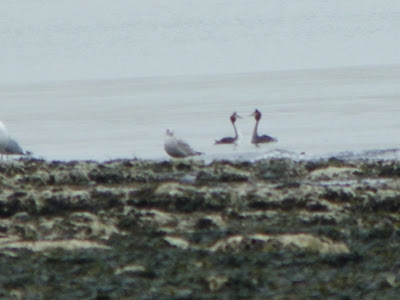
I followed the two of them along the undercliff, and as a result found a Fulmar nest above me, and got photographs of Oystercatcher and Curlew on the rockpools that were revealed with the tide. There were also several Rock Pipits along the cliffs holding territory, but I didn't get any photographs, hopefully within a month a walk along here might be greeted by their fantastic but often underlokked display flight.

Here the dedicated male is regurgitating food for his mate, presumably busy incubating their eggs

A Small oystercatcher in a big sea

While I was photographing the Curlew, a soft, whistling sound became apparent in the distance, which I identified as Wigeon. Gradually, it came closer, and closer, until eventually I saw about 100 of them flying out of Cuckmere Haven and out to sea. About 50 of these continued onwards and departed east, with the other 50 remianing offshore, at a distance of about half a mile, from whcih I somehow got this very distant record shot

After walking along the undercliff for about an hour, I eventually arrived at Cuckmere Haven. I didn't see anything else hugely interesting, but got a few decent photos, shwon below


a few Black-headed Gull images, taken from in the Cuckmere, with #1 being taken on the main river and#2 on the ditch that runs parallel to it on the West Side

and a nice chance to get Redshank and Oystercatcher in the same shot.

And finally, ending as I started, with an inquisitive looking pigeon in the dovecote at South Hill Barn!!

I also saw a migrating Meadow Pipit fly NW over the car park as I was unlocking my bike for the ride home.


However, I haven't quite ended. I saw a Tawny Owl, caught in our car's headlights on the way back from Brighton at about 7.30 pm. After the hard-earned year tick a few hours ago, this was somehwat luckier and somewhat easier!!! My yearlist is now 109 species., with the addtion today of Wheatear and Tawny Owl.

My Highlights of the day, as follows;
Red Fox-1 ran accross sheep fields near South Hill Barn
Peregrine-1 flying low NE over South Hill Barn
Starling-300+ in sheep pastures south of South Hill Barn
Common Frog-six clumps of Frogspawn counted in the small pond by the car park
Wheatear-1 in Hope Gap
Great Crested Grebe-a pair observed in courtship as they drifted east past Hope Gap, stopping off in Cuckmere Haven and still present in the bay when I last saw them
Wigeon-100 departing out to sea from the Cuckmere, with about half continuing east and the rest sitting on the sea half a mile offshore for atleast 10 minutes. 
Meadow Pipit-1 NW over the car park at 13:55
Related Posts Plugin for WordPress, Blogger...